Y-15 Takes to the Air: China’s New Medium Transport Aircraft with Clear A400M Influences
The new Y-15, with its configuration similar to the A400M but on a smaller scale, seeks to replace the Y-8/Y-9 and strengthen PLAAF's air logistics.
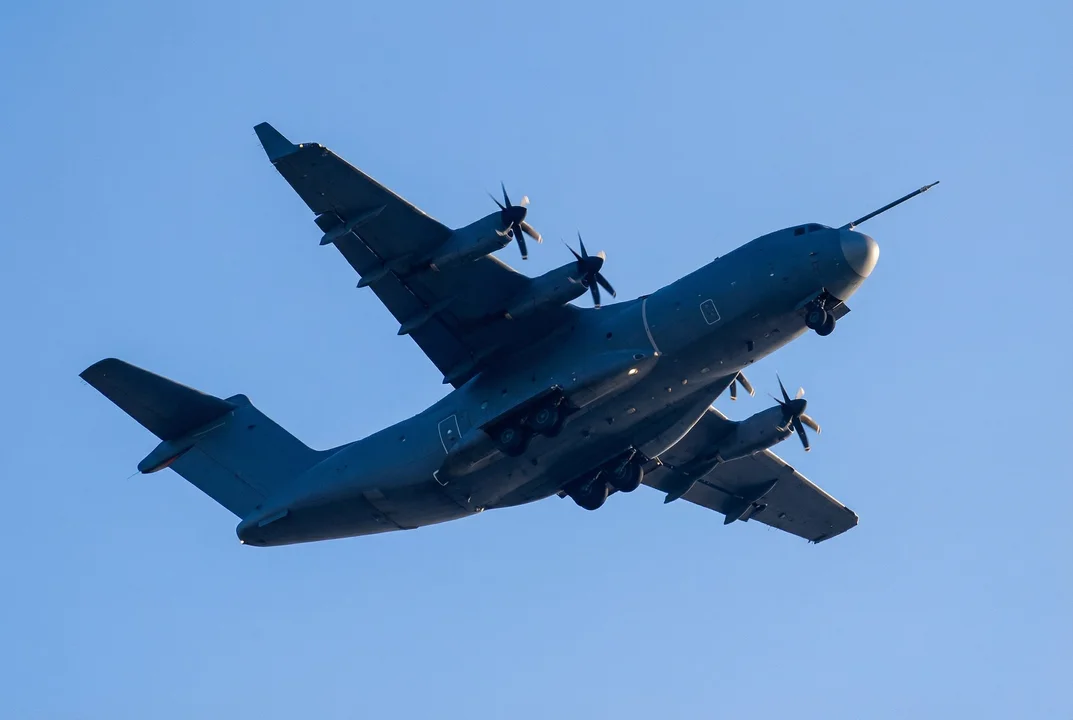
China has taken a significant step in the modernization of its airlift capabilities with the first flight of the Y-15, its new medium-class, four-engine turboprop military transport aircraft, recorded on December 16, 2025, in the Xi’an area. The event was confirmed through images and videos shared on social media and analyzed by specialized OSINT sources, in the absence—so far—of any official announcement by the PLAAF or AVIC.
In several posts, the aircraft appears identified as “Y-30,” an incorrect designation that traces back to the conceptual phase unveiled at Zhuhai 2014. Available evidence, including the visible prototype serial number (#15001), indicates that the correct designation of the aircraft currently flying is Y-15, while Y-30 corresponds to a preliminary label that has since been abandoned.
The Y-15 is designed to occupy a clearly defined position within China’s transport fleet: a modern medium airlifter, positioned between the Y-9 and the Y-20, intended to progressively replace the Y-8/Y-9 family derived from the Soviet An-12 and to reduce reliance on heavy strategic transport aircraft for regional missions.
The Y-15’s role and how it differs from its predecessors
From a technical and operational standpoint, the Y-15 represents a generational leap over the Y-9, without aspiring to the strategic role of the Y-20. It appears to be optimized for recurring logistical missions, rapid intra-theater deployments, and operations from limited infrastructure.
The configuration observed on the prototype supports this assessment:
- High wing and T-tail layout, optimized for rear cargo operations
- Wider fuselage than the Y-9, providing increased internal volume
- Rear loading ramp suitable for vehicles and standardized pallets
- Winglets—absent from previous generations of Chinese transport aircraft—aimed at improving aerodynamic efficiency and range
- Four next-generation WJ-10 turboprop engines with six-bladed high-efficiency propellers
Conceptually, the Y-15 appears to be strongly influenced by the Airbus A400M design, albeit on a smaller scale. Both aircraft share the idea of an intermediate transport capable of combining regional range, meaningful payload, and a degree of tactical flexibility. Unlike the A400M, however, the Y-15 does not appear intended to fill a strategic airlift niche.
Estimated capabilities and operational positioning
Although China has released no official specifications, the most consistent estimates allow the Y-15’s profile as a medium transport aircraft to be outlined with reasonable clarity:
- Estimated payload: around 30 tonnes
- Maximum range: approximately 5,500–7,000 km, depending on payload
- Propulsion: 4 × WJ-10 turboprops (~5,000 kW each)
- Segment positioning: above the Y-9, below the Y-20
This positioning makes the Y-15 a key platform for:
- Regional troop transport and medium-to-heavy logistics
- Humanitarian assistance and medical evacuation missions
- Rapid deployments from semi-prepared runways, at least in theory
The apparent objective is to close the gap between the Y-9 and Y-20 with a more efficient design, greater internal volume, and controlled operating costs per tonne transported.
Program status, uncertainties, and potential
The Y-15 program has followed a long and fragmented development path. After its conceptual unveiling in 2014, it remained largely dormant for years. Clear signs of reactivation only began to emerge in 2023, reinforced in 2024 by the use of a Y-8C as a flying testbed for the WJ-10 engine—a critical step in unblocking the program.
The flight of prototype #15001 marks the beginning of the flight-test phase, but it does not resolve all open questions. The main uncertainty remains the maturity of the WJ-10 engine, a critical factor for the program’s success in terms of reliability, fuel efficiency, and maintenance costs. The aircraft’s real-world performance from short or degraded runways, as well as its ability to sustain high payloads efficiently over time, also remains to be demonstrated beyond theoretical figures.
Beyond its eventual induction into the PLAAF, the Y-15 could have limited but non-negligible export potential, particularly among countries seeking to replace aging An-12 or C-130 fleets without access—due to political, economic, or industrial constraints—to Western alternatives. In segment terms, the aircraft would sit between the Airbus A400M and lighter platforms, with some conceptual similarities to the Kawasaki C-2, though without directly competing in the same mature markets. Compared to the Embraer C-390 Millennium, the Y-15 would offer greater internal volume and potential payload, but would not—at least for now—target the European market where the Brazilian aircraft is consolidating its role as a C-130 replacement.
In this context, it cannot be ruled out that the Y-15 could also serve as a vehicle for industrial and strategic cooperation, particularly with Russia, whose military transport aviation faces a structural crisis in the medium segment. Moscow urgently needs a replacement for its An-12 fleet, but efforts to revive domestic programs such as the Il-276 (formerly Il-214/MTA) have progressed slowly due to financial and industrial constraints. While any Russian participation in the Y-15 would, at best, be limited and politically sensitive, the Chinese aircraft could emerge as a transitional or complementary solution for the VKS if national programs continue to stall.
China appears determined to consolidate a modern, indigenous, and tiered transport aircraft family, free from reliance on legacy designs. If the Y-15’s development proceeds without major setbacks, the aircraft has the potential to become the standard medium transport of the PLAAF, acting as the logical link between tactical and strategic platforms and substantially strengthening China’s airlift capability over the coming decades.


