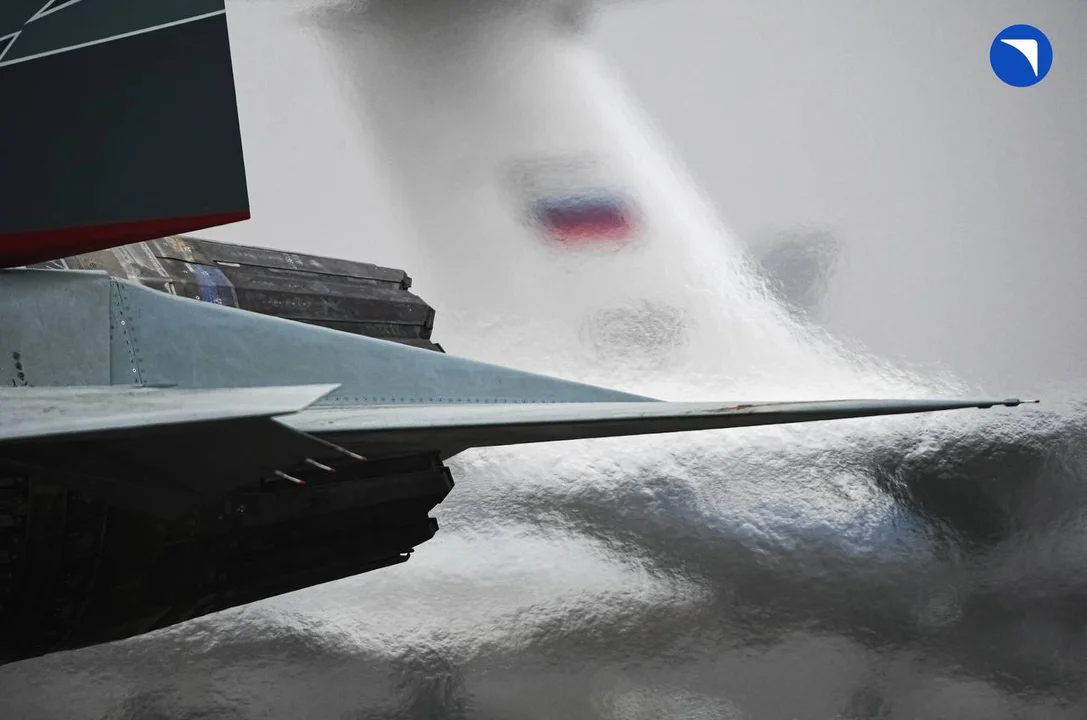
The Russian Air Force received the last batch of Su-35S fighters in 2025
UAC and Rostec closed the annual production plan after completing the planned deliveries to the Russian Ministry of Defense

The United Aircraft Corporation (UAC) of Russia, part of the state-owned Rostec conglomerate, has confirmed the delivery to the Russian Ministry of Defense of the final batch of Su-35S multirole fighter jets for 2025, thereby completing this year’s production and supply plan for the aircraft to the Russian Aerospace Forces (VKS).
According to the official statement released by UAC and Rostec, the aircraft successfully completed the full cycle of factory ground and flight trials before being formally accepted by VKS crews and transferred to operational units. The corporation did not disclose the exact number of aircraft included in this final batch, a common practice in Russian official communications related to the fulfillment of the state defense order.
A record year for fighter aircraft production
Rostec emphasized that 2025 became a record year for combat aircraft production, with the Su-35S manufacturing plan fully completed. In this context, the state corporation confirmed that the plants involved are already working on the 2026 production program, amid sustained operational demand and continued industrial effort.
“The Su-35S is one of the most in-demand aircraft within the forces. Its operational record includes the highest number of targets destroyed during the special military operation,” Rostec stated, also highlighting the aircraft’s ability to engage and neutralize targets at ranges of several hundred kilometers, as well as its capacity to employ the full range of modern air-launched weapons available in the Russian inventory.

Technical capabilities
The Su-35S, a deeply modernized evolution of the Flanker family, is designed for air superiority and strike missions, including operations in adverse weather conditions and at long distances from its home bases. The aircraft is powered by two AL-41F1S turbofan engines with thrust vectoring, providing supermaneuverability, a maximum speed exceeding Mach 2, and a combat radius of more than 1,500 kilometers. Its sensor suite is centered on the Irbis-E radar, capable of long-range target detection, tracking multiple contacts, and operating in both air-to-air and air-to-surface modes, complemented by the OLS-35 infrared search-and-track system and an integrated electronic warfare and self-protection suite.
During the war in Ukraine, the Su-35S has been primarily employed in interception, combat air patrol, and escort missions, as well as in support roles for strike operations. In this context, configurations combining medium- and long-range air-to-air missiles such as the R-77-1 and R-77M, together with short-range R-73 missiles, have been observed, enabling the aircraft to act as a dominant beyond-visual-range (BVR) platform within the Russian air order of battle. The use of Kh-31P/PM anti-radiation missiles has also been documented, expanding its role in suppression of enemy air defenses (SEAD) missions.
Additionally, the Su-35S has operated with extended-range air-to-surface weapons, including guided missiles and glide bombs equipped with planning and correction modules (UMPK), allowing stand-off attacks from dozens of kilometers outside the engagement envelope of short- and medium-range air defense systems. This payload flexibility, combined with twelve hardpoints and a maximum weapons load of up to eight tons, reinforces the Su-35S’s value as a true multirole platform in high-intensity conflict scenarios.
Seven batches delivered in 2025
According to OSINT monitoring, this delivery represents the seventh batch of Su-35S fighters produced and transferred to the VKS during 2025. Previous deliveries were officially announced in March, May, June, August, September, and November, indicating a sustained production tempo throughout the year.
Although neither UAC nor Rostec disclosed the size of each batch, audiovisual material released on previous occasions suggests deliveries of two to three aircraft per batch, reinforcing the perception of a staggered but steady production flow.